Nutrition
 Print this article
 Download the article
 Making an appointment
Pre-operative diet
Pre-operative bowel preparation
- Strict low-fiber diet for 7 days.
- 2 rectal lavages (Fleet Enema®…) the day before surgery.
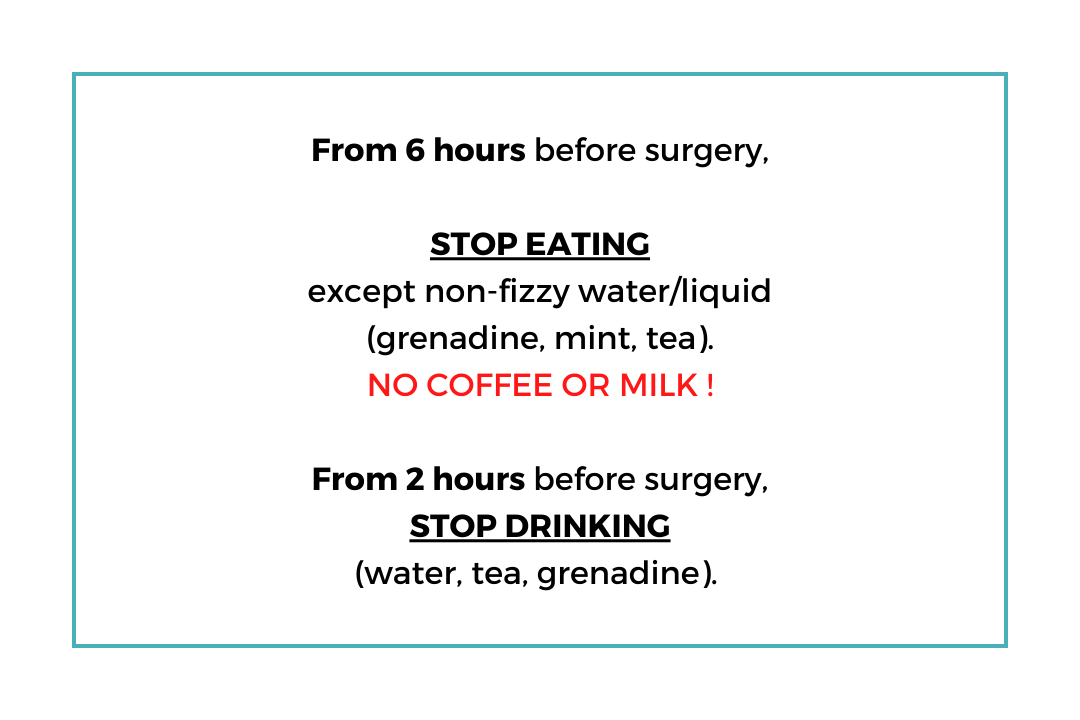
Stop eating and drinking
Strict low-fiber diet
- A strict low-fiber diet consists of cutting out foods rich in fibre. This restriction is maintained only temporarily.
- Each individual’s digestive tolerance should be taken into account, but unjustified and excessive restrictions should be avoided.
- Since fibers is essential for a balanced diet, it is important to reach a sufficient daily intake as soon as possible. You may then reintroduce non-refined starchy foods (brown bread, brown rice, etc.), 5 portions of fruit and vegetables a day, etc.
- Do not hesitate to contact the dietetic service to help you if necessary.
Hygiene and dietary rules
Respect some important principles:
- Eat your meals at regular intervals. Do not skip meals.
- Split your diet into 3 meals and possibly 1 or 2 snacks a day.
- Take your time to eat and chew your food sufficiently.
- Eat in a quiet environment.
- Drink 1.5L to 2L of drinks a day: water, herbal tea, tea, coffee.
Dietary advice
| Alternatives | Temporarily remove: |
| White rice, white pasta, white bread (toasted or not), biscuits, sandwiches, white pistolets, cornflakes or plain wheat, puffed rice, white flour, semolina, bulgur, potatoes |
High-fibre breakfast cereals (All Bran®, Fitness®,…), whole grain rice, whole grain pasta, whole grain bread, multigrain bread, Ebly® wheat, quinoa, oatmeal, muesli, whole grain flour |
| Fruit juices without pulp | All fruits (raw, cooked and fruit juices with pulp) Dried fruits (Agen prunes, dried apricots, dates, dried figs,…) Oily fruits (pistachios, walnuts, peanuts, almonds,…) |
| Bouillon Soup (filtered) |
All vegetables (raw, cooked, in soups) Legumes (lentils, chickpeas, dried beans, etc.) |
| Meat, poultry, fish, eggs, cold cuts and vegetarian alternatives based on tofu, seitan | Meat products with nuts Burgers and vegetarian alternatives based on Quorn® , tempeh, aforementioned vegetables, legumes |
| Ordinary and flavoured dairy products. Hard, soft, blue, fresh, processed cheeses |
Dairy products with cereals Cheese with nuts, hazelnuts and dried fruits |
|
Oils, butter, margarines, sauces,… |
/ |
| Jellies, fruit syrups, sugar, brown sugar,… Dry biscuits (cake, madeleine, Petit Beurre®, Betterfood®,…) |
Jam, marmalade Breakfast and cereal biscuits (Grany®, Sultana®, Belvita®,…) Chocolate with nuts, hazelnuts, almonds,… |
| Salt and ground spices (ground pepper, nutmeg and cumin powder,…) Herbal infusion |
Spices in granulated form (fennel seeds, coriander, pepper,…) Spices (onions, pickles, capers,…) Aromatic herbs (thyme, oregano, Provençal herbs, …) Poppy seeds, sesame seeds, sunflower seeds, linseed,… |
The list of foods is not exhaustive. Do not hesitate to ask your dietician for advice.
Our advice
- Avoid consumption of unpleasant foods: alcoholic drinks, strong tea and coffee, peppers and strong spices (pili-pili, harissa, green/red/yellow curry, cayenne pepper…).
If questions, you can always contact the dietary service:
St-Elisabeth site:
02/614.26.79
Ideas for meals
Breakfast
- White bread, sandwich, pistolets, white baguette or white biscuits, cracker, brioche
- Butter or margarine
- Topping: jam, fruit jelly, syrup, honey, bread spread, cheese or cold cuts (no spices, nuts, hazelnuts or dried fruits), eggs
- Or breakfast cereals + milk or yoghurt
- Other examples: French toast, pancakes
Second meal
- White bread, rolls, pistolets, white baguettes or white biscuits, pita bread, wraps…
- Butter or margarine.
- Salty toppings: cheese or cold cuts (without spices, nuts, dried fruits), eggs, fish, shellfish…
Examples:
Pancakes stuffed with prawns
Cheese and béchamel
Croque – monsieur ham and cheese
Boiled or fried egg or omelette
Tuna or salmon mousse
Cheese platter
Bouillon (broth) with tapioca or vermicelli
Hot meal
- Bouillon (hot water + stock cube, or vegetable and/or meat infusion)
- Meat, poultry, fish, eggs or unprocessed vegetarian alternative (seitan, tofu)
- White rice, white pasta, semolina, plain or mashed potatoes without skin
- Fat
Examples:
« Vol au vent » (without mushrooms) with rice
Pasta with béchamel sauce, ham and grated cheese
Minced meat gratin with mashed potatoes (minced meat without vegetables)
Veal blanquette (without vegetables) with mashed potatoes
White fish in cream sauce with potatoes
Minced steak with plain potatoes
Roast chicken with tarragon cream sauce and steamed potatoes
Snacks or as a complement to meals
Plain yoghurt or white cheese, flan, pudding, chocolate mousse, rice semolina, ice cream, biscuits (madeleine, Petit-Beurre®, waffle, boudoir, galette, meringue, etc.), sugar cake, rice cake, custard cake (cake without fruit or compote), etc.
Beverages
1.5l to 2l water, tea, coffee, herbal tea
Diet after surgery
Postoperatively, a low-fiber diet (not strict) is recommended for 2 weeks, after which a normal diet may be resumed.
- The aim of a low-fibre diet is the gradual reintroduction of dietary fibre into your diet. This is a transitional phase, taking into account your digestive tolerance.
- As fibers are essential for proper nutritional balance, it is important to reach a sufficient daily intake as soon as possible and to reintroduce unrefined starchy foods (brown bread, brown rice, etc.), 5 portions of vegetables and fruit per day, etc.
- Do not hesitate to contact the dietetic service to help you if necessary.
Hygiene and dietary rules
Respect some important principles:
- Eat your meals at regular intervals. Do not skip meals.
- Split your diet into 3 meals and possibly 1 or 2 snacks per day.
- Take your time to eat and chew your food sufficiently.
- Eat in a quiet environment.
- Drink 1.5L to 2L of drinks a day: water, herbal tea, tea, coffee.
Dietary advice
| Alternatives | Temporarily remove |
| White rice, white pasta, white bread (toasted or not), biscuits, sandwiches, white pistolets, corn or wheat flakes, puffed rice, white flour, semolina, bulgur, potatoes in all forms, tapioca | High-fibre breakfast cereals (All Bran®, Fitness®, etc.), whole-wheat rice, whole-wheat pasta, whole-wheat bread, multigrain bread, Ebly® wheat, quinoa, oatmeal, muesli, whole-wheat flour |
|
Fruit juices Cooked fruit without peel and seeds (e.g. canned fruit, stewed fruit, cooked apples, cooked pears, etc.), bananas |
Raw fruit Dried fruits (Agen prunes, dried apricots, dates, dried figs, etc.), bananas. Oily fruits (pistachios, walnuts, peanuts, almonds, etc.) |
| Soups and cooked vegetables such as: carrots, chicory, spinach, white leeks, extra-fine green beans, courgettes, pumpkin, cauliflower or broccoli, tomato,… |
All raw vegetables (grated carrots, corn,…) and salad Cooked vegetables such as: Asparagus, salsify, celery, mushrooms, Chinese cabbage, Brussels sprouts, sauerkraut, red cabbage, white and green cabbage, artichokes, peas, peppers, green leeks, fennel Onions, garlic, shallots Legumes (lentils, chickpeas, dried beans, etc.) |
| Meat, poultry, fish, eggs, cold cuts and vegetarian alternatives based on tofu, seitan | Meats with nuts, walnuts Burgers and vegetarian alternatives based on Quorn® , tempeh, aforementioned vegetables, pulses |
| Hard, soft, blue cheese , fresh and processed cheeses | Dairy products with cereals Cheeses with nuts, hazelnuts and dried fruits |
| Butter, margarine, sauces, | / |
| Jam, marmalade, jelly, fruit syrup, sugar, brown sugar,… Dry biscuits (cake, madeleine, Petit Beurre®, Betterfood®,…) |
Breakfast and cereal biscuits (Grany®, Sultana®, Belvita®,…) Chocolate with nuts, hazelnuts, almonds,… |
| Salt and ground spices (ground pepper, nutmeg and cumin powder,…) Aromatic herbs (thyme, oregano, herbes de Provence,…) |
Grain herbs (fennel seeds, coriander, pepper,…) Spices (onions, gherkins, capers,…) Aromatic herbs (thyme, oregano, herbes de Provence,…) Poppy seeds, sesame seeds, sunflower seeds, linseed,…) |
The list of foods is not exhaustive. Do not hesitate to ask your dietician for advice.
Our advice
- Avoid the consumption of unpleasant foods: alcoholic drinks, strong tea and coffee, peppers and strong spices (pili-pili, harissa, green/red/yellow curry, cayenne pepper…).
If questions, you can always contact the dietary service :
St-Elisabeth site :
02/614.26.79
Ideas for meals:
Breakfast
- White bread, sandwich, pistolets, white baguette or white biscuits, cracker, brioche
- Butter or margarine
- Toppings: jam, fruit jelly, syrup, honey, bread spread, cheese or cold cuts (no spices, nuts, hazelnuts or dried fruits), eggs
- Or breakfast cereals + milk or yoghurt
- Other examples: French toast, pancakes
Second meal
- Vegetable soup
- White bread, rolls, pistolets, white baguettes or white rusks, pita bread, wraps…
- Butter or margarine.
- Garnish: cheese or cold cuts (without herbs, nuts or dried fruit), eggs, fish, shellfish…
Examples
Crepes filled with prawns, cheese and béchamel sauce
Croque monsieur ham and cheese
Boiled or fried egg or omelette
Tuna or salmon mousse
Cheese board
Broth with tapioca or vermicelli
Hot meal
- Vegetable soup
- Meat, poultry, fish, eggs or unprocessed vegetarian alternative (seitan, tofu)
- White rice, white pasta, semolina, plain or mashed potatoes without skin
- Cooked vegetables (see list)
- Fat
Snacks or to supplement meals
Boiled fruit without peel and seeds (compote, boiled apple, boiled pear, tinned fruit, etc.), yoghurt or white cheese, fruit yoghurt, custard, pudding, creams, chocolate mousse, rice semolina, ice cream, biscuits (madeleine, Petit-Beurre®, waffle, boudoir, galette, meringue, etc.), sugar cake, rice cake, custard cake, fruit cake (apple, pear, etc.)
Beverages
1.5l to 2l water, tea, coffee, herbal tea
Nutrition and dietetic service
If you have any questions concerning pre or postoperative diet, please contact the dietetics service.