Haemorrhoid ligation
Operation
 Imprimer l’article
 Télécharger l’article
 Prendre rendez-vous
Indications
- Bleeding hemorrhoids Grade I – II:
Hemorrhoids do not slip out of the anal canal (Grade I), or sometimes during exoneration but they spontaneously re-enter the anal canal (Grade II).

Surgery
Ligatures of hemorrhoids are performed during consultation.
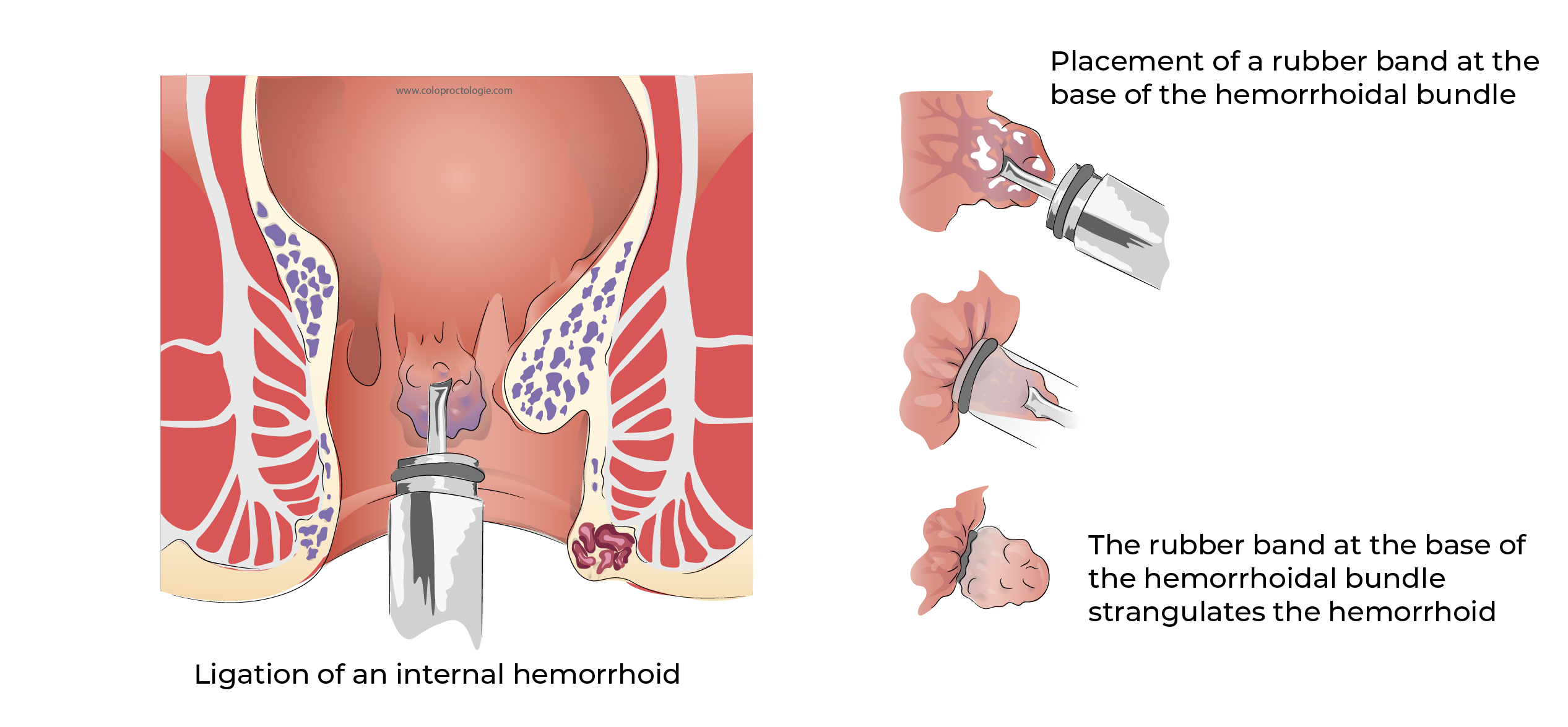
The hemorrhoid is aspirated into the device that subsequently pushes a rubber band around the hemorrhoid. The rubber band strangles the hemorrhoid which necroses and as a result the hemorrhoid shrinks. Because of the necrosis an the inflammatory reaction, scar tissue develops.
The scar tissue helps fixating the hemorrhoid in the anal canal.
This procedure can be repeated. Placement of ligatures can be repeated after 2 – 3 weeks. During the consultation, 2-3 ligatures may be applied.
This procedure can be combined with sclerotherapy.
The procedure should not cause severe pain.
When the hemorrhoid, strangulated by the ligature, is necrotic at 7 to 10 days, the ligature will fall off and will be disposed with the stools.
The loss of the rubber band may be accompanied with a small blood loss.

Treatment with ligatures is relatively contraindicated if anticoagulants are used, given the risk of bleeding.
(Lyerr VS, Long term outcome of rubber band ligation for symptmatic primary and recurrent internat hemorrhoids Dis Colon Rectum 2004; 47 ; 1364 – 1370)
Complications
Pain
If the ligature is placed too low in the anal canal, it may cause acute pain requiring the use of strong analgesics and sometimes removal of the rubber band.
- Pain and discomfort: 8 – 40%
- Severe pain: 3 – 20%
Bleeding after the procedure
-
Mild bleeding: 5.9 – 8.8%.
Recurrent bleeding:
-
10 – 40%
Infection
-
Extremely rare.
Normal – abnormal symptoms
Normal symptoms
- Anal pain is normal but should subside over time.
- A pressure in the anus and a false urge to defecate during the first days.
- Seepage of serous (yellowish) anal fluid.
- Fluid loss may be bloody but should subside over time.
Abnormal symptoms
Contact your surgeon or GP, or go to the emergency room:
- If pain increases over time.
- If fever does not subside over time.
- If pus volume increases or foul smelling viscous fluid increases.
- If blood loss persists.
If symptoms seem abnormal to you, contact your GP (general practician).
If this is not possible, contact your surgeon.
If you are unable to contact your GP (general practician) or surgeon, go to the St Elisabeth hospital emergency department.
Functional results
No abnormalities.