Fistulectomy
Operation
 Print this article
 Download the article
 Making an appointment
Indication
- Anal fistula that do not encompass more than 30% of the anal sphincter.
- Superficial fistula that do not cross the anal sphincter.
- Several factors are taken into account when choosing the surgical technique to treat anal fistula.
The most important factors are female gender, localisation of the fistula, continence and a history of anal surgery.

Surgery
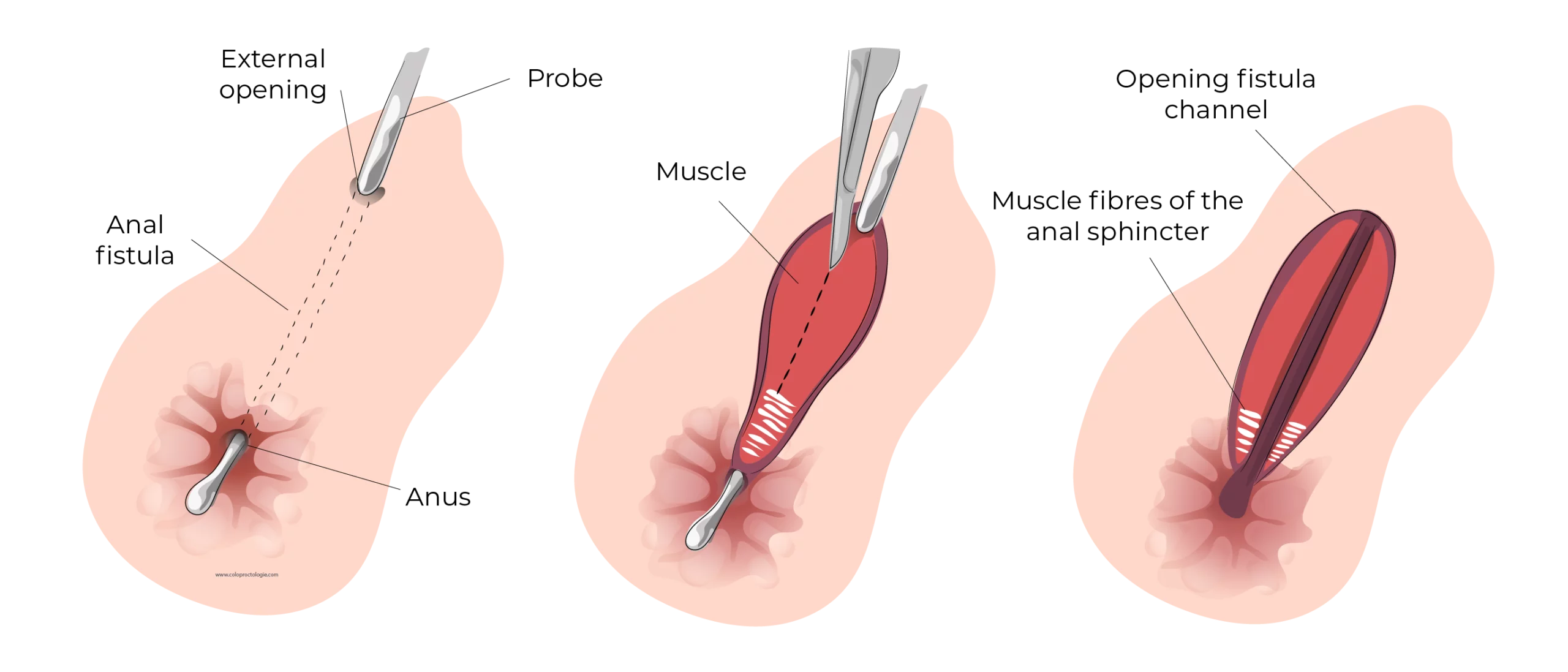
During the procedure, a metal button probe is used to locate the tract between the internal and external opening.
Depending on the amount of sphincter muscle, encompassing the fistula (more or less than 30% of the anal sphincter), the surgeon will decide whether to cut or excise the fistula trajet on the guidance of the stylet (fistulotomy or fistulectomy) or to perform another type of surgery (rectal sliding flap, ligature of the fistula trajet between the sphincters, etc.).
A fistulectomy usually involves cutting a small part of the anal sphincter.

Duration of the procedure :
- +/- 25 min
Length of hospital stay :
- Day admission
Wound healing :
- Up to +/- 4 weeks
Complications
Wound infection
- Incidence : 6%
Bleeding
- Incidence : 2,9%
Urinary retention
- Incidence : 2,6%
Recurrent fistula tract
- Incidence : 0 – 39%
Normal – abnormal symptoms
Normal symptoms
- Anal pain is normal but should subside over time.
- Seepage of serous (yellowish) anal fluid.
- Fluid loss may be bloody but should subside over time.
Abnormal symptoms
Contact your surgeon or GP, or go to the emergency room:
- If pain increases over time.
- If fever does not subside over time.
- If pus volume increases or foul smelling viscous fluid increases.
- If blood loss persists.
If certain symptoms seem abnormal to you contact your doctor.
If this is not possible, you can contact avec your surgeon.
If you are unable to contact your GP or your surgeon, go to the emergency department at St Elizabeth Hospital in Uccle.
Functional Results
Incontinence
If the anal fistula follows a simple tract and involves less than 30% of the anal sphincter, the risk of incontinence is minimal.
Uncontrolled gas loss may occur.
If the anal fistula is complex or runs high through the sphincter, another technique should be considered because the risk of incontinence is too high.
- Complex fistula
– Anterior fistula in gynecological position in a woman.
– Recurrence of an anal fistula.
– In cases of pre-existing fecal incontinence.
– Anal fistula with multiple external openings and tracts.
– Fistula after inflammatory bowel disease, radiotherapy, tuberculosis or malignancies.