Nutrition
 Imprimer l’article
 Télécharger l’article
 Prendre rendez-vous
Pre-operative diet
Pre-operative preparation
- Residue-free diet for 3 days before surgery.
- Laxatives: Two enemas in the evening, the day before surgery. (Fleet enema®, Fosfaat enema 130ml van Norgine®, Microlax®….)
The aim of the residue-free diet is to reduce the amount of bowel movements during surgery. For the same reason, 2 enemas are required before surgery.
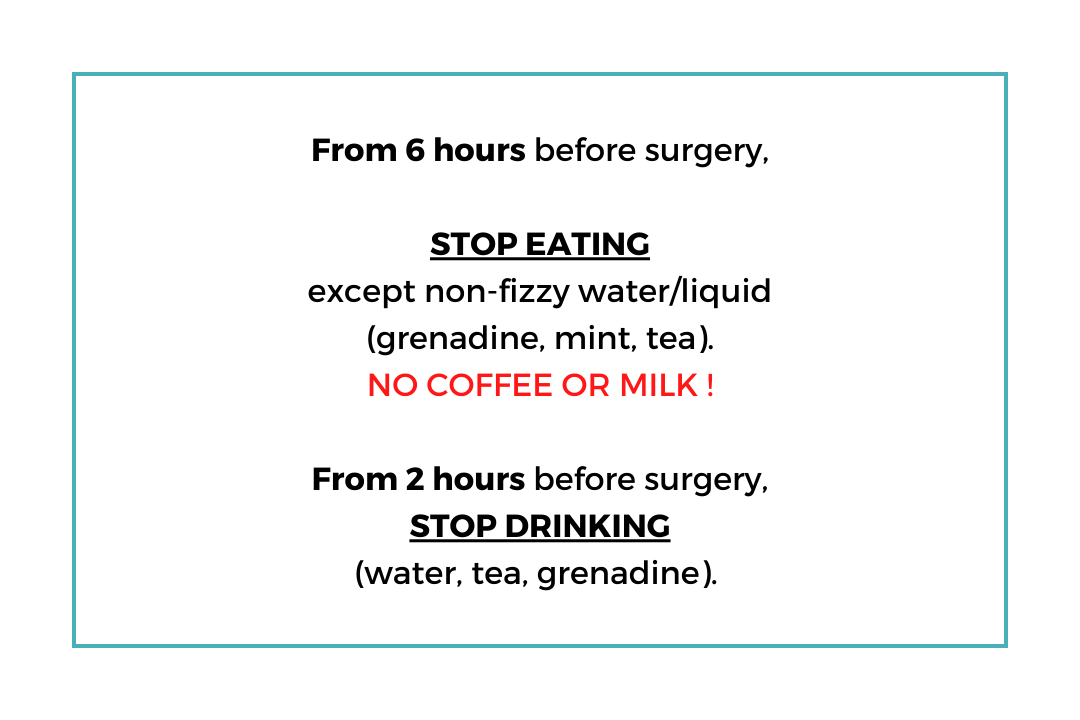
Stop eating and drinking
Strict low-fiber diet
- A strict low-fiber diet consists of cutting out foods rich in fibre. This restriction is maintained only temporarily.
- Each individual’s digestive tolerance should be taken into account, but unjustified and excessive restrictions should be avoided.
- Since fibers is essential for a balanced diet, it is important to reach a sufficient daily intake as soon as possible. You may then reintroduce non-refined starchy foods (brown bread, brown rice, etc.), 5 portions of fruit and vegetables a day, etc.
- Do not hesitate to contact the dietetic service to help you if necessary.
Hygiene and dietary rules
Respect some important principles:
- Eat your meals at regular intervals. Do not skip meals.
- Split your diet into 3 meals and possibly 1 or 2 snacks a day.
- Take your time to eat and chew your food sufficiently.
- Eat in a quiet environment.
- Drink 1.5L to 2L of drinks a day: water, herbal tea, tea, coffee.
Dietary advice
| Alternatives | Temporarily remove: |
| White rice, white pasta, white bread (toasted or not), biscuits, sandwiches, white pistolets, cornflakes or plain wheat, puffed rice, white flour, semolina, bulgur, potatoes |
High-fibre breakfast cereals (All Bran®, Fitness®,…), whole grain rice, whole grain pasta, whole grain bread, multigrain bread, Ebly® wheat, quinoa, oatmeal, muesli, whole grain flour |
| Fruit juices without pulp | All fruits (raw, cooked and fruit juices with pulp) Dried fruits (Agen prunes, dried apricots, dates, dried figs,…) Oily fruits (pistachios, walnuts, peanuts, almonds,…) |
| Bouillon Soup (filtered) |
All vegetables (raw, cooked, in soups) Legumes (lentils, chickpeas, dried beans, etc.) |
| Meat, poultry, fish, eggs, cold cuts and vegetarian alternatives based on tofu, seitan | Meat products with nuts Burgers and vegetarian alternatives based on Quorn® , tempeh, aforementioned vegetables, legumes |
| Ordinary and flavoured dairy products. Hard, soft, blue, fresh, processed cheeses |
Dairy products with cereals Cheese with nuts, hazelnuts and dried fruits |
|
Oils, butter, margarines, sauces,… |
/ |
| Jellies, fruit syrups, sugar, brown sugar,… Dry biscuits (cake, madeleine, Petit Beurre®, Betterfood®,…) |
Jam, marmalade Breakfast and cereal biscuits (Grany®, Sultana®, Belvita®,…) Chocolate with nuts, hazelnuts, almonds,… |
| Salt and ground spices (ground pepper, nutmeg and cumin powder,…) Herbal infusion |
Spices in granulated form (fennel seeds, coriander, pepper,…) Spices (onions, pickles, capers,…) Aromatic herbs (thyme, oregano, Provençal herbs, …) Poppy seeds, sesame seeds, sunflower seeds, linseed,… |
The list of foods is not exhaustive. Do not hesitate to ask your dietician for advice.
Our advice
- Avoid consumption of unpleasant foods: alcoholic drinks, strong tea and coffee, peppers and strong spices (pili-pili, harissa, green/red/yellow curry, cayenne pepper…).
If questions, you can always contact the dietary service:
St-Elisabeth site:
02/614.26.79
Ideas for meals
Breakfast
- White bread, sandwich, pistolets, white baguette or white biscuits, cracker, brioche
- Butter or margarine
- Topping: jam, fruit jelly, syrup, honey, bread spread, cheese or cold cuts (no spices, nuts, hazelnuts or dried fruits), eggs
- Or breakfast cereals + milk or yoghurt
- Other examples: French toast, pancakes
Second meal
- White bread, rolls, pistolets, white baguettes or white biscuits, pita bread, wraps…
- Butter or margarine.
- Salty toppings: cheese or cold cuts (without spices, nuts, dried fruits), eggs, fish, shellfish…
Examples:
Pancakes stuffed with prawns
Cheese and béchamel
Croque – monsieur ham and cheese
Boiled or fried egg or omelette
Tuna or salmon mousse
Cheese platter
Bouillon (broth) with tapioca or vermicelli
Hot meal
- Bouillon (hot water + stock cube, or vegetable and/or meat infusion)
- Meat, poultry, fish, eggs or unprocessed vegetarian alternative (seitan, tofu)
- White rice, white pasta, semolina, plain or mashed potatoes without skin
- Fat
Examples:
« Vol au vent » (without mushrooms) with rice
Pasta with béchamel sauce, ham and grated cheese
Minced meat gratin with mashed potatoes (minced meat without vegetables)
Veal blanquette (without vegetables) with mashed potatoes
White fish in cream sauce with potatoes
Minced steak with plain potatoes
Roast chicken with tarragon cream sauce and steamed potatoes
Snacks or as a complement to meals
Plain yoghurt or white cheese, flan, pudding, chocolate mousse, rice semolina, ice cream, biscuits (madeleine, Petit-Beurre®, waffle, boudoir, galette, meringue, etc.), sugar cake, rice cake, custard cake (cake without fruit or compote), etc.
Beverages
1.5l to 2l water, tea, coffee, herbal tea
Diet after surgery
High-fiber diet and hydration
The diet should be followed for at least four weeks so that the wound in the anal canal can heal, without being traumatized by hard stools that can injure the scar.
This will also help reduce post-operative pain.
The high-fiber diet is based on the consumption of high-fiber foods to improve intestinal transit and combat constipation.
Hygiene and dietary rules
Respect some important principles:
- Eat your meals at regular intervals. Do not skip meals.
- Split your diet into 3 meals and possibly 1 or 2 snacks per day.
- Take your time to eat and chew your food sufficiently.
- Eat in a quiet environment.
- Drink 1.5L to 2L of drinks a day: water, herbal tea, tea, coffee.
Dietary advice
Progressively increase consumption of high-fiber foods.
Eventually, eat enough of the following foods every day:
- Starches: wholemeal bread, oatmeal, quinoa, rice and wholemeal pasta,…
- Fresh fruit and vegetables: the recommendation is 2 portions of fruit and 3 portions of vegetables a day.
- Dried vegetables: lentils, chickpeas, peas, dried beans,…
- A handful of dried fruit or oilseeds: prunes, apricots, figs, almonds, walnuts,…
Drink enough
You need to drink 1.5 to 2L of water a day in addition to your food. In fact, certain fibers work by absorbing water. Drinking waters rich in magnesium will stimulate your transit (e.g. Hépar®, Contrex®, Orée du bois ®…).
Regular physical activity, with prior medical advice
Regular physical activity helps regulate transit.
Adopting good elimination habits
The urge to have a bowel movement after a meal is triggered by a reflex mechanism that causes waves of contractions in the intestines. It’s important to respond to the urge to have a bowel movement when it arises. Avoid holding back. Defecation should take place without time pressure and in a calm atmosphere.
Enriching your diet with fiber
You can also add fiber in the form of oat bran, flaxseed or psyllium to foods such as compotes, yoghurts, dairy desserts,…
If questions, you can always contact the dietary service :
St-Elisabeth site :
02/614.26.79